NCERT Class 4 Mathematics Hindi Medium Textbook
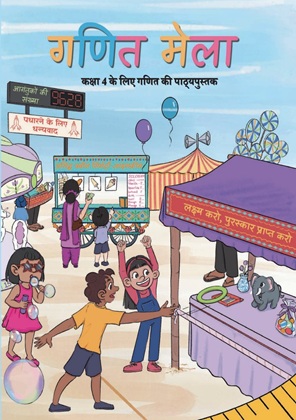
NCERT Class 4 Mathematics Hindi Medium Textbook PDF Download
English, Hindi
By NCERT
Mathematics is not merely a school subject; it is a life skill that helps children understand patterns, solve problems, and make sense of the world around them. At the primary level, the way mathematics is introduced plays a decisive role in shaping a child’s attitude toward the subject. Recognizing this importance, the National Council of Educational Research and Training (NCERT) has designed the Class 4 Mathematics Hindi Medium textbook titled “Ganit Mela” with a learner-centred and joyful approach. Ganit Mela presents mathematics as an exciting exploration rather than a collection of rules and formulas. Through relatable situations, colourful illustrations, and activity-based learning, the textbook transforms abstract concepts into meaningful experiences. It aims to build confidence, curiosity, and a deep understanding of mathematics among young learners.
FREE PDF Download

NCERT Class 4 Mathematics Hindi Medium Textbook: An Engaging Journey into the World of Mathematics
Mathematics is not merely a school subject; it is a life skill that helps children understand patterns, solve problems, and make sense of the world around them. At the primary level, the way mathematics is introduced plays a decisive role in shaping a child’s attitude toward the subject. Recognizing this importance, the National Council of Educational Research and Training (NCERT) has designed the Class 4 Mathematics Hindi Medium textbook titled “Ganit Mela” with a learner-centred and joyful approach.
Ganit Mela presents mathematics as an exciting exploration rather than a collection of rules and formulas. Through relatable situations, colourful illustrations, and activity-based learning, the textbook transforms abstract concepts into meaningful experiences. It aims to build confidence, curiosity, and a deep understanding of mathematics among young learners.
Philosophy Behind Ganit Mela
The core philosophy of Ganit Mela is that every child can learn mathematics when it is taught in a friendly and meaningful way. The book rejects rote memorization and encourages understanding through observation, reasoning, and participation. The metaphor of a “mela” (fair) is symbolic—each chapter is like a stall offering a new experience, inviting children to explore and enjoy learning.
The textbook aligns with the principles of the National Education Policy (NEP) by promoting experiential learning, critical thinking, and real-life application of knowledge. Mathematics is shown not as an isolated academic subject, but as a practical tool used in daily life.
Language and Child-Friendly Presentation
Although the textbook is designed for Hindi Medium students, its pedagogical style is universally effective. The language is simple, conversational, and age-appropriate, allowing children to grasp concepts without anxiety. Instructions and explanations are framed in a friendly tone, often addressing students directly, which creates a sense of interaction.
Key language features include:
Simple sentence structures
Familiar day-to-day vocabulary
Contextual explanations
Logical progression of ideas
This approach ensures that students focus on understanding concepts rather than struggling with language.
Major Topics Covered
1. Numbers and Place Value
Children learn to read, write, compare, and arrange large numbers. Estimation and logical reasoning help strengthen number sense and confidence in handling numbers.
2. Addition and Subtraction
Operations are explained using everyday situations such as counting items, calculating expenses, and solving practical problems. This helps children understand the purpose of calculations.
3. Multiplication and Division
Multiplication is introduced as repeated addition, while division is explained through sharing and grouping activities. Visual models make these concepts easy to understand.
4. Measurement
Concepts of length, weight, and capacity are taught using real objects and standard units like metres, kilograms, and litres. Students learn by measuring items around them.
5. Time
Reading clocks, understanding daily routines, calendars, and time intervals develop time awareness and planning skills.
6. Money
Through realistic examples of buying and selling, students learn to handle money, calculate totals, and find balances—an early introduction to financial literacy.
7. Shapes and Patterns
Two-dimensional and three-dimensional shapes, symmetry, and patterns enhance spatial thinking and creativity.
8. Data Handling
Simple tables, pictographs, and charts introduce students to organizing and interpreting data in an engaging way.
Activity-Based Learning: Learning by Doing
One of the most powerful strengths of Ganit Mela is its emphasis on activity-based learning. Instead of passive listening, students are encouraged to:
Measure objects
Observe patterns
Solve puzzles
Work in groups
Discuss their thinking
These activities promote curiosity, collaboration, and independent thinking. Learning becomes an active process where students discover concepts rather than memorize them.
Role of Illustrations and Visual Learning
The textbook is enriched with bright, meaningful illustrations that support understanding and engagement. Scenes from markets, fairs, homes, and playgrounds help children relate mathematics to their everyday experiences.
Visuals help in:
Simplifying abstract ideas
Enhancing memory retention
Making learning enjoyable
Reducing fear of mathematics
The lively design ensures sustained interest and motivation.
Practice, Assessment, and Skill Development
Each chapter contains thoughtfully designed exercises that test understanding rather than rote calculation. The questions vary in type and difficulty, catering to different learning levels.
Assessment features include:
Application-based problems
Open-ended questions
Thinking and reasoning tasks
Real-life problem scenarios
This approach nurtures higher-order thinking skills and encourages students to explain their reasoning.
Support for Teachers and Parents
For Teachers
Ganit Mela provides flexibility and creative freedom in teaching. It supports:
Group activities
Classroom discussions
Continuous assessment
Learner-centred teaching
For Parents
Parents can easily connect textbook concepts to daily life—shopping, measuring ingredients, reading time, or managing expenses—making learning meaningful at home.
Long-Term Educational Impact
The NCERT Class 4 Mathematics textbook Ganit Mela builds a strong conceptual foundation for future learning. It helps students develop:
Logical reasoning
Analytical thinking
Confidence in problem-solving
Practical mathematical skills
By presenting mathematics as a useful and enjoyable subject, the book fosters a positive learning attitude that benefits students in higher classes.
Conclusion
The NCERT Class 4 Mathematics Hindi Medium textbook “Ganit Mela” is an outstanding example of child-friendly curriculum design. Its activity-based approach, simple language, engaging visuals, and real-life connections make mathematics accessible and enjoyable for young learners.
Rather than treating mathematics as a subject to be feared, Ganit Mela celebrates it as a tool for understanding the world. It successfully transforms learning into a joyful journey, ensuring that students not only learn mathematics but also develop a lifelong appreciation for it.